
Our projects fall under a number of themes:
Data Science/Clinical Informatics
Our lab uses large-scale clinical data — particularly secondary mental health care electronic health records (EHR) — to research the biology and seek treatments for psychiatric disorders. We use EHRs to investigate real-world outcomes, treatment trajectories, and service use patterns in psychosis and depression. We are particularly interested in using routinely collected biomarkers, including bloods. We are part of the Clinical Informatics for Mind and Brain health (CLIMB) group at the Department of Psychiatry.
As an example, we use patient-derived data to make inferences about the cardiometabolic and immune effects of mental illness and related conditions. One example is this ongoing project, where we are modelling weight gain upon starting the first antipsychotic medication in people experiencing a first episode of psychosis.
Selected publications:
- In this work we looked at inflammation in psychiatric inpatients (EHR, descriptive epidemiology).
- Here we studied longitudinal psychiatric outcomes in people with psychosis, based on baseline inflammatory and cardiometabolic markers (EHR, descriptive epidemiology).
Clinically useful risk prediction modelling
As part of this theme, we use use routinely collected data to produce clinical risk prediction models, which are statistical models that can be turned into clinical decision support tools that can support clinicians. One such models is MOZART:
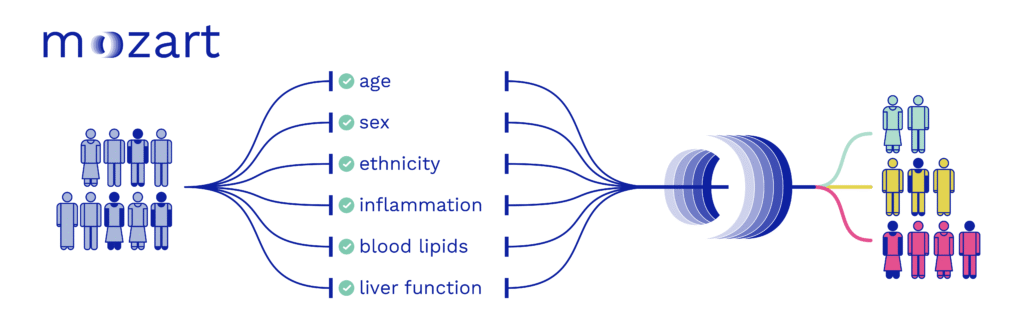
MOZART is the first clinically useful, externally validated model predicting treatment resistance in schizophrenia using routinely collected clinical data. Treatment-resistant schizophrenia affects up to one-third of patients and is associated with poor outcomes and high healthcare costs. Early identification enables timely initiation of clozapine—the only effective treatment—reducing morbidity and improving recovery. MOZART is now being prepared for regulatory approval by MHRA, with the aim of future NHS implementation, representing a major step toward personalised psychiatry.
Selected publications:
- Here we contributed to the development of the first psychosis-specific clinical risk prediction model for cardiometabolic outcomes (EHR, clinical risk prediction modelling).
- Here we developed MOZART, a risk prediction model for treatment resistance in first episode psychosis (EHR, clinical risk prediction modelling).
Clinical and Translational Research in Psychiatry
We are part of the NIHR Mental Health Translational Research Collaboration (MH-TRC), a group of centres and investigators in experimental medicine and early-stage translational mental health research from across the UK working to implement discoveries into clinical practice.
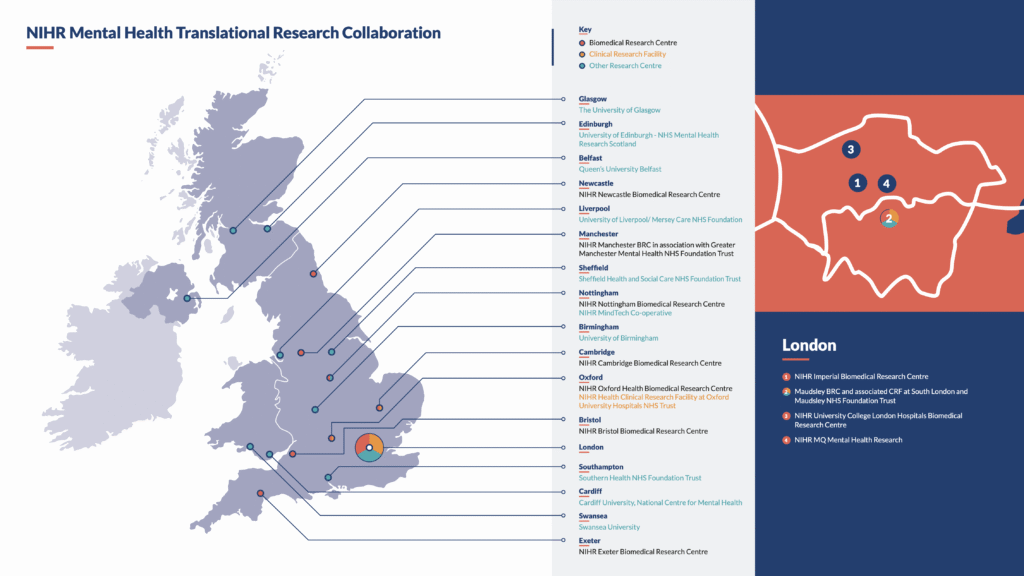
Graham co-leads the Early Psychosis Workstream of the MH-TRC Mission, which has been funded to deliver, among other things, the Early Intervention Mission.
The Early Intervention Mission (Chief investigator: Graham Murray. Co-I and local PI: Emanuele Osimo) is a national study designed to enhance outcomes for young people experiencing first-episode psychosis and to build infrastructure to evaluate service models, develop digital tools for monitoring and engagement, and conduct pragmatic trials embedded in routine care.
The study is recruiting 2,000 people with early psychosis and 500 “healthy” controls.
The project integrates clinical data, biological measures, and patient-reported outcomes to inform personalised care strategies.
Emanuele is involved in both the Early Psychosis Workstream and the Mood Disorders Network of the NIHR MH-TRC Mission – being, among other roles, co-lead of the CPFT Mood Disorders Clinic.
Selected publications relating to translational research:
- In this work we recruited and assessed/scanned a cross-sectional cohort of people with chronic schizophrenia and matched healthy controls, and observed changes in cardiac function, structure, and blood biomarkers, suggesting a biological pathway.
- We are currently working on the Protocol for the Early Intervention Mission – should be published soon.
Epidemiology and Genetic Epi

This research focuses on the use of large population-based datasets to explore the origins and early risk factors of mental illnesses such as depression and psychosis. The aim is to identify modifiable risk factors that could inform early intervention and prevention strategies.
This research is based on multiple datasets including UK Biobank and public GWAS datasets.
In a related strand, we apply methods such as Mendelian Randomisation to explore potential causal relationships between risk factors (e.g., inflammation, metabolic traits) and mental health conditions. These techniques help disentangle correlation from causation in complex psychiatric disorders.
This is a current project.
Selected publications/preprints:
- We have helped to measure the associations between inflammatory conditions, depression and psychosis, through large population-based datasets, with the aim of understanding more about the links between inflammation and serious mental illness.
- We are finalising work to measure associations (through MR) between protein levels in the blood (proteomics) and mental illness.
Genomics and Bioinformatics
Our bioinformatics research focuses on the genetic architecture of psychiatric disorders.

We explored the role of tissue-specific enhancers in increasing the amount of liability explained by the genetic factor (thesis).
Current work aims at investigating the contribution of rare variants to common disease risk, particularly schizophrenia. Here is a preprint.
Brain Imaging
The group has investigated brain structure and function in psychosis and depression using neuroimaging. We use multimodal imaging techniques—including structural MRI, functional MRI, and diffusion imaging—to study neural correlates of cognitive dysfunction, symptom dimensions, and treatment response.
Recent work has focused on identifying neurobiological subtypes of psychosis and mapping brain networks involved in social cognition and reward processing. These studies aim to refine diagnostic categories and support the development of targeted interventions.